Have you ever wondered how the huge stone hillforts of the Iron Age emerged? Do you want to experience Spanish heritage and culture in a completely new way? If your answer is yes, then THIS is your chance.
Ler en Galego / Lea en Español
We are the people of Costa dos Castros and we’re crowdfunding an excavation with DigVentures in an attempt to find out more about the huge stone hillforts that dominate our landscape.
You can support our project from a distance and choose some amazing archaeological benefits in return, or you can go one step further and become an Archaeology Ambassador…
What is an Archaeology Ambassador?
Jump on a plane to Spain this October and we’ll wine you, dine you and show you the very best of the archaeology in our area. By becoming an Archaeology Ambassador, you’ll be helping us get Costa dos Castros the international archaeological attention it deserves.
You can see more about the programme here. If you really love archaeology, and are interested in European rock art and hillforts, then this will make a huge difference to the project. Come and see the Bronze Age rock art, the Iron Age hillforts, and help us put Costa dos Castros on the archaeological map!
Background
Costa dos Castros is a small, but stunning strip of coastline in Galicia, on the Atlantic coast of Spain. Our home is a hidden gem, a place that isn’t a ‘destination’, and hasn’t yet been ‘discovered’, but definitely deserves to be.
We, the people who live here, own and manage the land collectively. We make decisions about the land together, manage the woods together, farm and do agriculture together. But there’s more to our land than that.
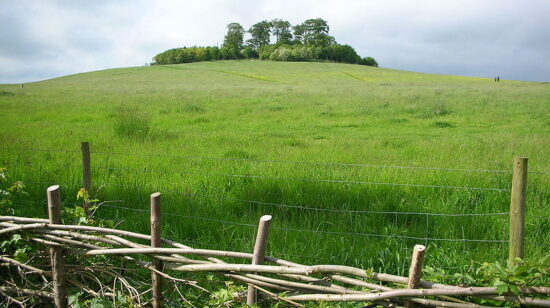
A string of huge stone hillforts line these rocky shores; they’re the remains of an ancient Iron Age culture and you can help us uncover the story of the people who built them over 2,000 years ago
It’s these hillforts which give our land (Coast of the Hillforts) its name, and among them there’s evidence that the people who built them were already in contact with Mediterranean traders over 2,000 miles away, long before the Romans ever arrived in the area.
Why did they build so many hillforts in one small area? What did they want from the Mediterranean traders who came here? And what did they give them in return? We recently joined together to form the Costa dos Castros Association and we’re inviting YOU to help us find the answers, and explore the ancient links between Atlantic and Mediterranean cultures that go back over 3,000 years.
Tell me about the archaeology
The Atlantic Bronze Age was a period in which both ideas and commodities were traded up and down the Atlantic coast of Europe, from Scotland and Ireland all the way down into Spain and Portugal. These exchanges gave rise to many of the cultural symbols we now think of as Celtic, including domestic roundhouses, bronze axes, rock carvings, spiral motifs and (of course)… hillforts!
Costa dos Castros is one of the most western points of Atlantic Europe, but it was once at the very heart of this trade route and today we still have the evidence… A string of impressive Iron Age hillforts lining the rocky shores, and undergrowth filled with hidden rock carvings.
Tell me what you’re looking for
What’s really unusual about Costa dos Castros is that so many hillforts were built in such a small space; twelve have so far been identified within a 7km stretch, but why?
We know the hillsides are rich in tin (a crucial ingredient for making bronze) and over the last few years, small excavations have unearthed bronze axes, Punic pottery, tools, weapons, domestic roundhouses and defensive buildings. There’s even a rock carving depicting a Mediterranean ship.
The influence that Atlantic and Mediterranean cultures had on eachother is a relatively unexplored archaeological story, and yet Costa dos Castros is clearly a place where Atlantic and Mediterranean cultures collided thousands of years ago, and are still interacting to this day.
Having so many hillforts in one location also makes it the perfect place to study how hillfort culture evolved, not just in Galicia, but throughout Atlantic Europe. It’s time to carry out more in-depth excavations, so that Costa dos Castros can add to the body of evidence about hillfort culture, find out more about the people who built them, and their long-standing connections with the people of the Mediterranean over 2,000 miles away.
Tell me which hillfort you’ll be excavating
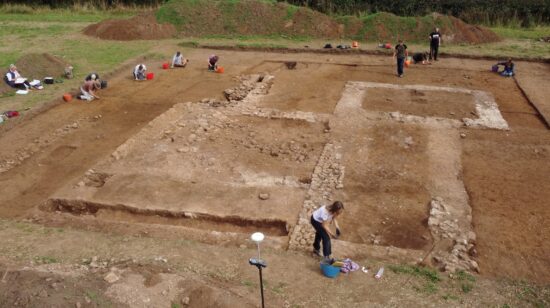
The crowdfunded excavation will focus on one particular hillfort called A Cabeciña. This is where the bronze axe, pottery and some of the evidence of Mediterranean trade was found during a small excavation last year. The hillfort also has three clear phases of occupation and construction, which means we can look at how the site grew and evolved over time.
Hillforts weren’t just defensive, they were also domestic and A Cabeciña has already shown signs that it was a relatively large and densely-packed community with many roundhouses built inside its outer walls. We plan to excavate one of the roundhouses that we already identified and hope that as we dig, we’ll find more evidence of daily life, as well as international trade.